
An Essential Guide to Website Resilience and ROI
Key Takeaways
- Internal Pitfalls: Long-term growth is frequently undermined by internal fatigue—the tendency for organizations to abandon functional strategies for quick fixes and personal opinion.
- The Impact of Brand Inconsistency: Frequent shifts in visual and verbal identity compromise your external credibility. Sustained brand equity requires the discipline of repetition to turn single interactions into long-term customers.
- The Strategic Objective: Brand authority is the product of well-thought-out design and incremental refinement. Success is found in the discipline of optimizing a functional foundation.
What is Website Resilience?
We define website resilience as the ability of the asset to maintain its aesthetic and functional integrity and value as a business scales.
We’ve seen website design and content degrade too quickly, too often. A lot of our work is designing and building websites; we love them, so we’re especially sensitive to this. A business invests significant time, resources, and emotional energy into crafting a meticulously thought-out, purposeful, and beautiful website. It’s perfect, brand-aligned, user-centric, and poised for long-term success.
Then the decay begins, sometimes before the new site is launched. At first, the decay is barely noticeable—reminiscent of the “boiling frog” syndrome, where a slow burn toward mediocrity feels normal until it’s too late.
If we were to distill all of the potential causes of website decay down to their core, the reason is that the website doesn’t represent real opportunity for revenue and growth to the people who matter the most.
Why Does Website Decay Happen so Often?
Contributing factors include a lack of a web-focused business plan, feature creep, low-quality content, insufficient performance reporting, desperation, and shifts in leadership. Understanding these factors is the first step in ensuring a positive ROI for your website.
Ruining a website is rarely intentional. It’s a confluence of factors that exert a gravitational pull towards mediocrity.
Why the Lack of a Web-focused Business Plan can Lead to Failure
We should just insert “How to Write a Business Plan” here. We’re not suggesting that all businesses need a separate business plan for their web operations, but they do need a plan.
A website’s business plan focuses on how it will reach the right audience and lead to more conversions.
- The plan should start with a website-focused brand strategy: target audience, competitive research, brand voice and personality, brand positioning, and monetization strategy.
- If it requires a revenue model, it needs to be clearly defined.
- A realistic budget for marketing and updates is vital.
- If there is a connection to a physical location, the plan should include a strategy on how the site will drive traffic to the storefront or facility.
- If it is connected to a retail store, the website plan needs to cover a strategy for online inventory and other functionality to maximize users’ connection to the brick-and-mortar store.
- A plan for concise and consistent reporting on the specific goals used to measure success.
How "Feature Creep" Degrades a Great Website
A website is rarely static, and most of us know that adding a pop-up notification, a new lead-generation form, additional category pages, or a banner ad is relatively easy. These are all well-intentioned and needed site elements. Unfortunately, these incremental additions are often bolted on without considering how they impact the overall design system. In our world, each of these has already been accommodated in the delivered design system, but that is not always the case.
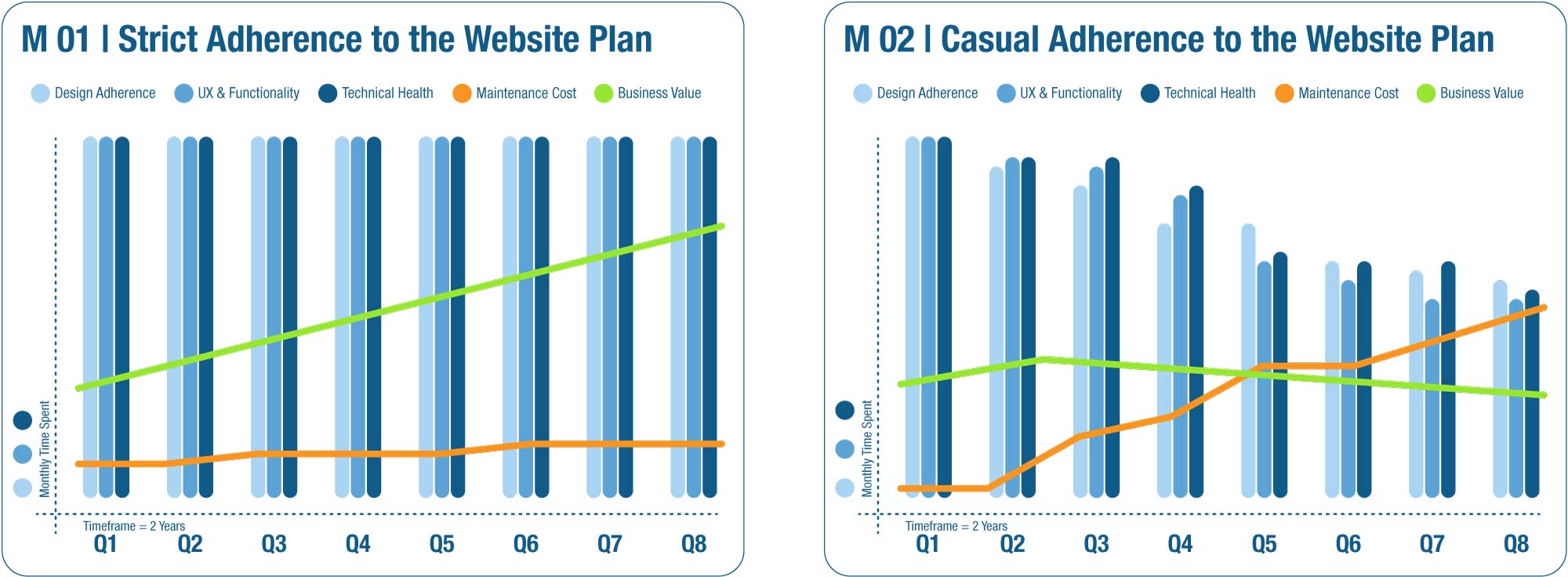
This is where lack of discipline and care start to create a design debt. Design debt is the cumulative negative result of suboptimal, rushed, and inconsistent design and technical decisions made during a website’s maintenance and modification.
Why Maintaining Web Design Requires Operational Discipline
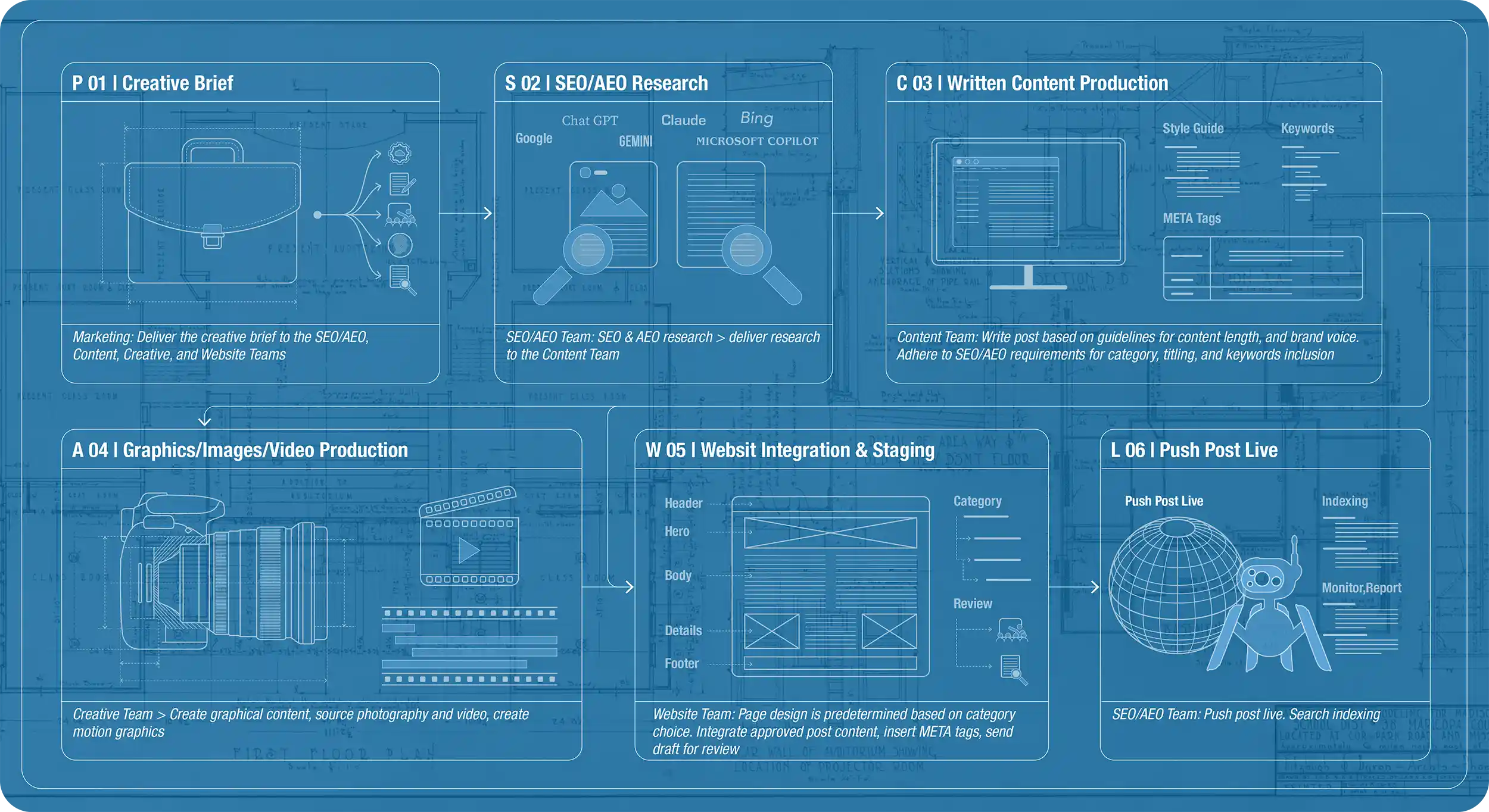
Purposeful, elegant design and great content require constant discipline to modify, maintain, and create. Successful websites depend on concise character counts, precise image aspect ratios, and consistent audits and updates of technology. They also depend on a steady flow of worthwhile content and SEO & AEO. Maintenance requires discipline, specifically, advocacy from leadership, special skill sets, and strict adherence to design guidelines.
Examples
- Someone from Marketing needs to update the site, but a designer is unavailable. To get the updates done quickly, the marketing associate is tempted to take the path of least resistance. They paste text that breaks the grid, or has embedded HTML which creates inconsistency.
- There is no I.T. department and the backend technology is monitored by a designer. For them, there is little connection to the tech that drives the website. Their limited monitoring and naïveté see the website’s speed degrade, more users bouncing, and search results diminish due to the reduced performance.
The Impact of Data and Short-term Thinking on Long-term Brand Equity
We are all for data-informed decisions. However, a narrow focus on short-term metrics can lead to design decay. Sometimes an A/B test reveals that an “ugly” neon yellow button gets 0.5% more clicks than the beautifully integrated, brand-aligned call-to-action. We have seen this lead to that same off-brand color being used for emphasis throughout a website.
The mistake is prioritizing a small boost over long-term brand equity and a holistic user experience. Chasing every micro-optimization without considering the overall impact often results in a website that looks like every other generic, high-conversion landing page—stripped of its unique brand “soul” for a slight stats bump.
How Leadership Changes can Erode Website Strategy
A successful website usually has an internal “champion” – an owner, CEO, or Product Owner with a clear vision and a deep understanding of why the site looks and functions the way it does. When that person leaves or their focus shifts, the new stakeholders may only see the surface-level aesthetics without understanding the strategic depth. Without that champion and gatekeeper, the design system and site’s focus can begin to erode.
The Effects of Website Decay
We have observed companies invest in and launch remarkable websites. Daily pressures can lead to a slow drift toward ineffectiveness. This decay can create significant pain. Ultimately, without a commitment to design and functional integrity, a high-value digital asset can become a liability.
A website that has strayed from its original design and functional intent creates a multitude of problems:
- Diluted brand identity
- Degraded user experience
- Loss of internal enthusiasm and advocacy
- Reduced competitive advantage
- Wasted investment
Best Practices for Maintaining Website Integrity and Long-Term ROI
We approach design as an aesthetic exercise as well as creating a long-term business asset. Understanding the factors above is the first step. If needed, the second step is changing how a business views website ownership.
The Myth
The Reality
Design is a one-time project.
Design is an ongoing operational habit. Every new piece of content or feature is a design decision that must adhere to the design system.
Beauty is “extra.”
Purposeful beauty and refinement create “trust equity” that converts better over time. It’s a fundamental part of user perception and confidence.
More features = more value.
More features can mean more friction, more noise, and lower brand clarity. We like to ask “What can be removed?” Less can be more.
Conclusion: Trust Yourselves and Website Fatigue Is Not Allowed
There’s been significant investment in your new website, and for it to succeed long-term, trusting your strategic decisions, approved prototypes, and technical specifications is mandatory. Of course, there will be modifications, but these will be an evolution, not oversights and careless additions. With this, your website is much more likely to deliver on its plan for customer acquisition and revenue growth.
Equally important is diligent maintenance. A website requires ongoing care, strict adherence to its design system, and designated custodians who understand the original intent and can assess all updates to ensure it is retained.