
Key Takeaways
- Word of Mouth is Different Now: In 2026, traditional internet search, AI search, and Local Search—including your social presence—have become a vital version of modern word-of-mouth. This is often the primary way customers find, verify, and experience the ‘vibe’ of a small business.
- The Power of Incremental Search Engine Optimization: Consistent, small improvements to content and your site’s technical health accumulate to build lasting authority without requiring a large upfront budget.
- Answer Engines are the New Search: AI ‘Answer Engines’ like Gemini and Perplexity prioritize trust. Providing high-quality content and user-intent-driven FAQs is now the fastest way to be cited as a verified source.
- Consistency is a Trust Signal: Keeping your “entity” data (Name, Address, Phone) identical across all maps and platforms is a major ranking factor for both AI and Local Search.
- Speed is Non-Negotiable: Fast load times are essential across all devices. High performance prevents users from bouncing and ensures search engines prioritize your site over slower competitors.
What is SEO?
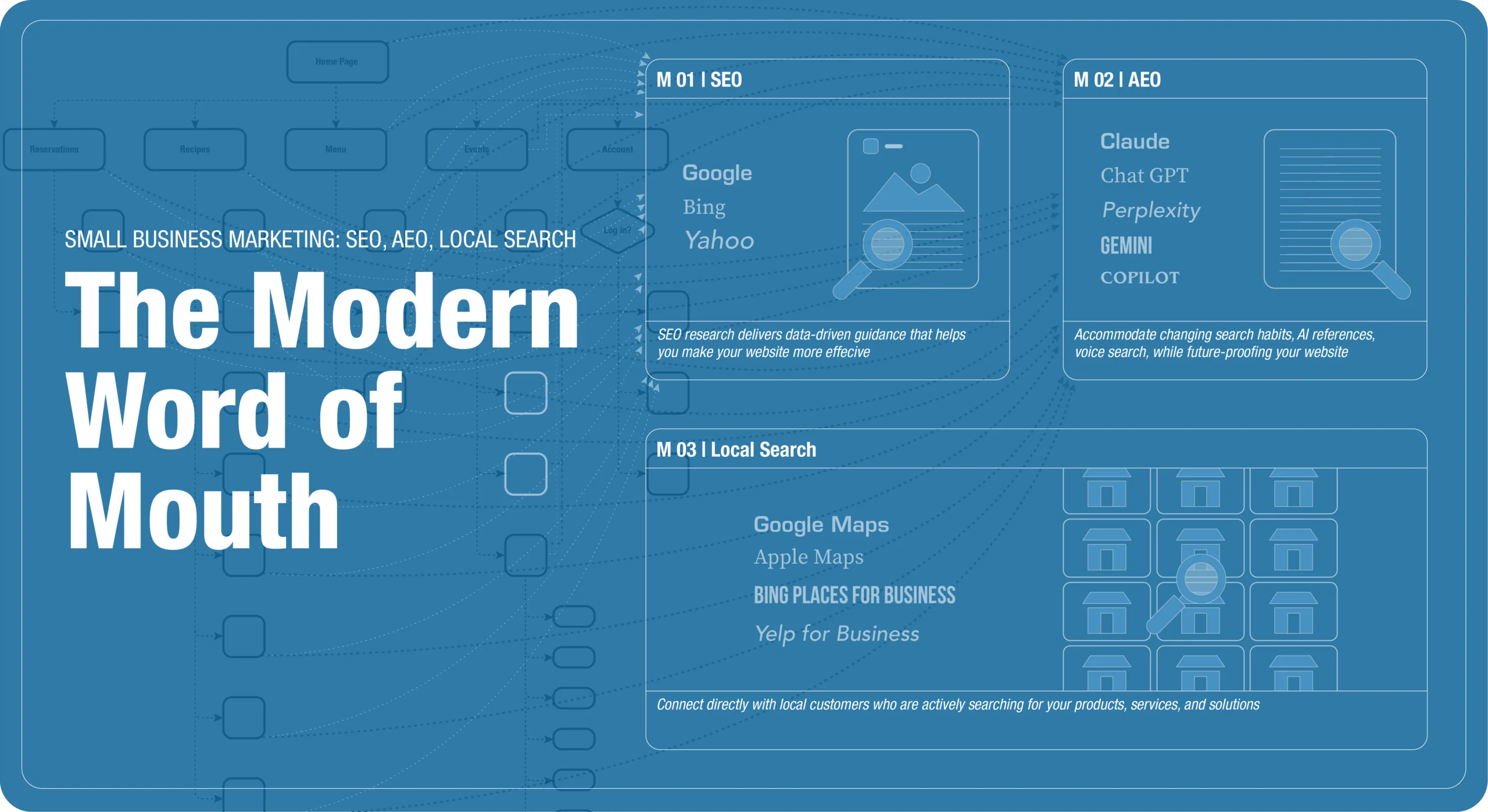
Search Engine Optimization (SEO), Answer Engine Optimization (AEO), and Generative Engine Optimization (GEO), along with Local Search, are how many new customers will find, verify, and ultimately choose to visit you. Search optimization is the process of crafting or improving a website to increase its visibility in search engines and answer engines. This involves optimizing content, structure, and technical aspects of a website to rank higher in search results, appeal to popular answer engine prompts, and drive more organic (non-paid) traffic to your website and maps applications like Apple and Google Maps (local search).
- Search Engines power web searches from browsers and some search functionality in apps and websites. Google, Bing, and Yahoo are the three most prominent Search Engines in America, with Google owning about 90% of the market.
- Answer Engines provide the AI Overview that resides at the top of Google’s, and other’s web searches. This is by far the most popular AI search.
- Generative Engines are the AI search tools that respond to users’ prompts. Perplexity, ChatGPT, and Google Gemini are popular Generative Engines.
- Local Search is a vital piece of most SMBs’ overall SEO strategy. It connects businesses with local customers who are actively searching for immediate solutions. This drives high-intent traffic to your website and physical locations. Most importantly, it also increases visibility in Google Maps and Apple Maps.
Why Does a Small Business Need SEO, AEO, GEO, and Local Search?
Small Business (SMB) marketing is very different in the digital era. The “Word of Mouth” that most SMBs rely on isn’t as effective as it once was. Now, customers find you and are motivated to visit through search results and reviews. Along with Social Media, this is the modern word of mouth.
If your website isn’t being found, then you aren’t being found—a little harsh, perhaps, but only a little. Customers will still find you the old-fashioned way, but much of your vibe and trust are built through traditional and AI search results, along with Local Search results.
Often, your business is listed on Google Maps, Apple Maps, and other Local Search platforms by the platforms themselves. Maps and Local Search applications have a vested interest in businesses being listed, so some of your work is usually done for you. The valuable work starts once you claim your business and begin implementing Local SEO.
How Much Should You Spend on Search Optimization?
Let’s assume you want to be on the first page of search results and referenced in AI searches for important prompts. The cost and value depend on your target audience, geographic presence, and market. It’s significantly easier for a regional architectural firm to achieve the top-of-first-page results than it is for an e-commerce business that sells jeans and t-shirts.
Based on the above, a small local business could spend $6,000 over 3-6 months with a good SEO professional and see good-to-great results. From our experience, a $1,500 – $2,500 per month budget (3-12 months) that includes Local SEO is a sweet spot for SMBs and will provide a great ROI.
If you wanted to spend less, you could dive down the rabbit hole and DIY it. The good news is that with the DIY approach, you can slowly and effectively build on any SEO work you do.
Incremental Search Optimization—What It Is and Why It's Great for Small Businesses
Incremental SEO, AEO, and GEO is when you make small but consistent improvements to your website and business profile. This could include content updates, technical modifications, or internal linking. The positive effect of this kind of SEO accumulates over time and will drive growth.
Rather than rushing to see instant results, the incremental approach focuses on building long-term results and authority through consistent improvements to your website’s user experience and adapting to search engines.
By focusing on high-impact, incremental wins, SMBs can avoid the typical large budgets of complete search optimization. You contribute what you can, when you can, and if those modifications are high-quality and data-driven, your ROI will continue to improve.
How "Incremental" can be an Advantage for Small Business AEO
In 2026, Answer Engines (Perplexity, Gemini, ChatGPT, Claude, et al.), prioritize trust and verification. Authenticity and quality rule.
The Incremental Advantage
- Authenticity and Quality: Slow, steady updates often reflect a real business’s natural growth and make it clear that you are an entity on the move. Search and Answer Engines love a website that is growing.
- Accuracy: It’s easier to ensure one page is 100% great than to try to optimize 5 pages at once.
- Refinement: You can use data from the previous months to dictate where you spend your time and budget moving forward.
Getting Started—The First Incremental Sprint
1. Optimize for AEO and GEO
AI overviews in Google et al, and in AI engines like Gemini, Claude, and Perplexity crawl websites looking for direct answers to users’ questions. Your FAQs are more likely to be those exact answers.
- The Task: Identify the three most common questions your customers asked this week.
- The Action: Create a “Help” or “FAQ” section on your site. Write the question as an H2 header and provide a clear, concise answer (40–60 words) immediately below it.
- The Value: This structure makes it incredibly easy for an AI model to “scrape” your site and credit you as the source of the answer.
2. Create Visual Authority
For businesses where “seeing is believing,” your images are data points. In 2026, AI “sees” your portfolio to verify your expertise.
- The Task: Select all images on your website that have generic names like Project1.jpg or IMG_34253.png.
- The Action: Rename them with descriptive, keyword-rich titles (e.g., modern-sustainable-home-design-austin.jpg) and write Alt Text that describes the technical detail of the work, menu item, or product.
- The Value: This turns a static gallery into a searchable database for “Visual Search” and AI verification.
3. Entity Consistency
To an AI, your business isn’t just a website; it’s an entity. If your information is inconsistent across the web, the AI loses trust in you. This makes Local SEO very important.
- The Task: Audit your NAP (Name, Address, Phone number) on Google Business Profile, Apple Maps, Yelp, and other Maps and Local Search applications. Also, review your website’s footer and contact page.
- Do the same for all of your social profiles.
- The Action: Ensure every single character—including “St.” vs “Street”—is identical across all platforms.
- The Value: Consistency is a very large trust signal. It tells the “Answer Engines” that your data is reliable enough to show to a user.
4. Technical Weight Loss
Speed is a non-negotiable ranking factor in 2026. In Google PageSpeed Insights, a rating of 90–100 is vital. Slower websites risk being ignored by potential customers and search engines. Ideally, your website should load within one to two seconds on desktop and mobile devices.
- The Task: Run your homepage through a speed test (like Google PageSpeed Insights).
- The Action: Usually, the biggest culprit is oversized images. Spend 30 minutes compressing your top 5 images or converting them to smaller file sizes in .webp format. A .webp image delivers high quality and a smaller file size compared to .jpg and .png.
- There can be other aspects of your site that prohibit a high score: large JavaScript files, font loading method, and page structure are among some of the things that can slow down your website.
- The Value: A faster site improves user retention and makes it more likely search bots will index your content quickly.
Search Tools—Google Search Console and Performance Reporting
We don’t want to sugarcoat it; these tools take some getting used to. They’re worth the effort because once you gain some expertise, the way you use them becomes almost automatic.
Google Search Console—a Direct Line to Google Search and Answer Engines
Google Search Console (GSC) lets you announce your business’s presence on the Internet. It allows you to connect directly to Google, where you submit your sitemap to verify your platform’s existence.
When you make incremental updates, you use GSC to request that the modified pages be re-crawled. This ensures your changes show up in search results and AI more immediately, rather than weeks later. GSC also acts as a diagnostic tool, telling you exactly which pages are being “ignored” and why, so you can fix the issues and resubmit them.
Lastly, Search Console measures your keywords and page performance in searches. It’s rudimentary, but it does work, and it’s free.
Google Analytics—Quantifying Your Activity
Google Analytics 4 (GA4) serves as the definitive record of human engagement. In the current search landscape, success is defined by user intent and interaction. GA4 utilizes a tracking model to provide granular insights into how visitors navigate your site—revealing which of your incremental content updates are resonating and which are being ignored.
You can configure specific “Key Events,” such as form submissions or click-to-call actions, which move you beyond basic metrics and into specific performance tracking. This data-driven approach ensures that every investment you make is informed by actual user behavior, allowing you to refine your strategy and maximize your digital presence.
Conclusion: Just Start
The digital landscape in 2026 rewards consistency over intensity. You don’t need a massive agency budget to see results; you just need to start. Whether you use a search specialist or go full DIY, every incremental change will move you closer to better search results—and potentially the top of the page.
As we navigate the shift from traditional search to AI-driven answers, businesses that win will be the ones that prioritize content focused on your audience, authenticity, and technical health. Incremental search optimization is a budget-friendly strategy, but it’s also a highly effective way to stay agile in a rapidly changing environment.